

|
BMW Engine Oil
Engine Oil for your BMW
If you have ever researched engine oil and gave up because of the never-ending debates, acronyms, and unsubstantiated claims, hopefully this page will 'click' for you. What we want to do is educate our customers and other enthusiasts who might have a casual understanding of engine oil and want to learn more. From our racing programs, project cars, service work, and our own personal experience we have accumulated deep understanding of what oil should be and what it isn't. We're not oil chemists or engineers and not part of the API (an oil industry trade group) so these are our impressions based on experience and research.
TL;DR:
- Allow oil to reach optimum temperature before driving hard - 210-220°F if you have an oil temp gauge. Without a gauge wait until the coolant temp gauge is at normal center position.
- Use a high quality oil if you expect high performance. With engine oil you absolutely get what you pay for - pay a little more and you get better oil.
- Match your oil to your engine spec and mileage, which may not be what's in your owner's manual.
- Our recommended oil change interval is 5,000 miles.
- Get a regular used oil analysis done to observe internal engine wear as well as oil compatibility.
- Get out and drive! Avoid short trips where oil never reaches optimum temp and moisture doesn't burn off. Once up to temp, open the throttle(s) and give your engine the opportunity to recirculate oil.
Click here if you just want to skip ahead to our BMW model oil recommendations.
There are a lot of acronyms and unfamiliar terminology used in oil discussions. Refer to the chart at the bottom of the page for their meanings and importance.
Basic Oil Knowledge
Engine oil has four functions: lubrication, protection, cooling, and cleaning. In other words: performance, longevity, durability, and emissions. Engine internals are all metals: steel, aluminum, magnesium, titanium, etc. Metal-on-metal contact creates friction, which creates heat and wear on both surfaces. Oil is pumped or scattered around the engine block, crankshaft, connecting rods, piston bottoms, and pumped up to the cylinder head to eliminate or reduce metal-on-metal contact. The best motor oils will coat the engine internals in a strong layer of lubrication and hold its strength even under extreme heat. The more heat and stress and a higher quality oil is required. That's the really basic stuff.
API Ratings on the Bottle
If you shop for oil at a big box store you have very little info to go by on the bottle (but a lot of marketing!). You get two required bits of information: SAE oil viscosity ("5W40") and an API rating ("SN"). "S" is for automotive Service but there are also "C" codes for commercial/Diesel vehicles. In essence the API rating indicates what the oil formula is and what it's intended use is. With each new major formula revision a new rating is released. API ratings began in the 1920s but there have been six new ratings just within the last 30 years! See "More Fuel-Efficient Engine Oil" below.
API states that the current rating of SN is backwards compatible to previous ratings going back to SJ in the early 2000s. But we believe in matching oil to your current engine's mileage and equipment. An SN oil developed for direct injection and ceramic catalytic converters may be compatible with your older BMW but that doesn't make it the most appropriate. Below we'll try to explain the most recent API ratings and how they apply to BMW models.
API SP. Released in 2020. Details to follow but this standard explicitly mentions 0W20 and 0W16 oil weights and direct injection.
API SN. Intended for 2007+ gasoline direct injection cars with ceramic catalytic converters instead of metallic cats. As large amounts of zinc and phosphate (ZDDP) and carbon ash (SAPS) are harmful to the ceramic material, they have been replaced with other additives. More detergents have been added to prevent carbon and sludge build-up (see the section below on Direct Injection engines). This is not bad oil for these engines and if you still have factory cats this is the oil rating you should be using. Bonus points if the bottle carries a Mercedes 229.5 (MB229.5) approval as Mercedes standards are among the highest of OE manufacturers. If you need extra protection for track use or aggressive driving, switch to a thicker viscosity.
API SM. 2005-2010 models but this doesn't really apply to BMW. Use an SN oil for a car that retains all of its factory equipment.
API SL. 2005 or older. Many people consider SL to be the last "good oil" before ZDDP levels were reduced. We recommend an SL oil for pretty much all cars built before the E90 generation: E85, E83, E63, E60, E53, E46, E39, E38, Z3, E36, E34, and E32. It can be used in E30 and older models too but only in thicker viscosity. These cars can use an SN oil but SL is much more appropriate. It can also be used in newer cars (E9X, F3X, etc) that have had cats removed (such as race cars) or street cars converted to metallic cats. The higher ZDDP levels will be advantageous in aggressive driving.
API SJ. 2001 and older. The original formula for cars built in the 1990s or older but you're not likely to find it anymore. See API SL above.
The BimmerWorld View: If you're going to use an older API oil on a newer car (SL on a E92 335i or F82 M4, for examples) you must be aware of the differences. The higher ZDDP and SAPS will shorten the life of a factory ceramic catalytic converter. It could also clog the catalytic converter leading to a major loss of power or engine damage. You must allow the oil to reach operating temperature - no heavy throttle until warm and avoid short trips. Keeping the oil warm-hot will help in proper oil burning and re-circulation. If other mods dictate higher ZDDP you should really consider an aftermarket metallic cat.
Oil Base Stock
When is a synthetic not a synthetic? When it's a blend! To understand oil quality you have to first know of the base stock. This is the absolute purest form of lubricating oil that every brand starts with. There are three types that you will encounter:
Group III. Petroleum based with synthetic additives. BMW-approved oils must be a Type III. If you want a BMW stamp of approval it must be a Type III, even though it is not a full synthetic and IV and V are a better basis for high-performance oil. Many Group III oils will use PAO and/or ester synthetics in their blend and are quite capable as good oil, until you ask too much of it. The chemical strength of the petroleum base can only do so much.
Group IV. True synthetic using poly-alpha-olefin (PAO). The true synthetic allows engineers to tailor a Group IV oil to be stronger than a III oil. This is especially important in sheer strength where a III oil would break down and allow more friction. IV oils can also be engineered to have less evaporation, leaving a better lubricating oil behind even under extreme temps. The PAO formula seems to offer the best of all worlds.
Group V. True synthetic using esters. These oils are also true, full synthetic and will exceed the strength of a Group IV in critical areas. They are more miscible than a IV oil so it mixes with other chemicals easier. Group V esters also have drawbacks that limit their application to being an additive for IV oils. Esters tend to also be more expensive to produce.
Ultra premium oils will draw from Type IV and V base stocks to create a blend suitable for their needs. No one Group is better than the others but they each have specific strengths that make them more appealing for certain uses. Create a formula using a mix of IV and V and you have the best of all worlds.
Product Labels & Marketing
Most premium oil brands label their products as "full synthetic" when they are really a blend. If you look at the ingredients published on most MSDS (Material Data Safety Sheet) or "Physical Properties" the first ingredient will be "petroleum", "hydro-", or "synthetic base oil". Any large percentage of petroleum content is NOT a "full" synthetic. The "false advertising" laws in the US are more lax than elsewhere in the world. Many of the ultra-premium oils in the US could not be labeled as full synthetic in other parts of the world. This doesn't mean we're getting bad oil in the US, or that Group III blended oils will not perform well, but at best you're getting a "really good Group III oil". A Group III oil may even surpass a IV/V oil in certain tests and may be more appropriate for specific situations. Red Line produces truly synthetic oils using Group IV and Group V base stocks, except in specific cases where they "downgrade" their oil to get an OE approval. Base stock is not the only determining factory in oil quality and performance but it is a big one.
BMW Engine Oil Approvals
Just like API ratings, BMW revises their oil formulations every few years based on contemporary engine design, mileage and emissions requirements, fuel type and quality, region, service plans, and marketing. Each new spec is coded by year and roughly corresponds to new generations of BMW engines (example: LL-01). However, they will also revise the LL ratings to work with contemporary engines. The LL-01 was overhauled in 2018 to be relevant to contemporary engines. Newer LL approvals do not supersede previous versions unless specifically noted. These ratings are just a guide so that the appropriate oil is used for your engine design. And like our API approach we recommend using a BMW oil spec that matches your BMW engine model and type. For a full description of each Approval, see the BMW-specific section below.
More Fuel-Efficient & Cleaner Engine Oil
Since the 1990s, stricter EPA and CARB (California Air Resources Board) regulations have forced engine oil into a massive overhaul to make engines more efficient and cleaner. The newest oil specifications have made oil thinner with less friction and drag on internal surfaces, especially the oil pump. This has made the engines burn less fuel but at the expense of protection. The latest oils break down easier at high temps and do not provide as much protection, especially the common brands found at big box stores. Despite the marketing blitz, these big name oils have been reformulated more for emissions compliance. Additives and components that made oil "good" were removed because they were either too harmful for the environment or deemed unnecessary for a new generation of engines and driving habits. They have been replaced with alternative additives that are not as good. All of these new regulations add up to a cleaner environment but it comes at the expense of quality and performance. Engine oil has actually gotten "worse" in recent years, especially as performance is increased and engines accumulate wear.
Various Types of Oil to Buy
Big Box off-the-shelf. Shopping from any of the chain stores will give you plenty of options for modern engine oil. These are almost always API SN rated oils for the engines built within the last ten years. And always aimed at the mass-market DIY person. If you use your BMW for commuting or exclusively on the street there is very little downside to a big box oil and frequent oil changes (4,000-6,000 miles).
Big Box Premium. In rare cases you will find a higher-performance brand in addition to the usual brands. A lot of this is marketing and you will find the same API ratings and Type III base stocks as the others. But these have marketing behind them to make them appear as a premium oil. If you use your BMW for commuting or exclusively on the street there is very little advantage to these oils versus a cheaper brand, especially with frequent oil changes (4,000-6,000 miles).
Ultra Premium. We consider these to be the Group IV and Group V oils that are true synthetics. These are from true specialty oil manufacturers like Red Line or Motul, and certain LiquiMoly and Amsoil products. Their chemical engineering puts them in a class above and at a higher price point so it's rare to find these at big box or chain stores. They are not produced to meet a pricing goal, they are engineered to be great oil.
Specialized. Also from premium manufacturers are certain niche oils that are engineered for a certain market. Pay close attention to the bottle and marketing as these may be highly beneficial depending on your engine specs. The Red Line Euro formula comes to mind as it's one of the few oils specifically engineered for BMW LL-04 specs.
The Diesel Oil Alternative. Diesel oil has been exempt from EPA regulations to remove Zinc additives so it's overall better at coating metal surfaces. The heavy-duty Diesel oil also contains detergents that clean internal surfaces. Engine builders will often recommend Diesel oil for the first oil fill because it cleans away grease and other chemicals used in engine assembly. Buying Diesel oil from a big box store has become risky since the manufacturers are shifting to more environmentally friendly formulas. Also realize that higher ZDDP is not good for modern ceramic catalytic converters. We also have no experience using Diesel oil on the track or under high stress so we may continue to recommend a Red Line product for those conditions. But for older (pre-2006) street-driven BMWs with higher mileage the Diesel oil may be a decent choice for an off-the-shelf oil.
Racing Oil. Red Line and others produce "Racing Oils". This is not marketing and there are actual differences that you should be aware of. True racing oil differs from normal oil in 2 ways: ZDDP content and additives. Race oils contain extremely high ZDDP content for superior strength. Strength is required for prolonged engine use at high RPM and high stress, such as extended laps on a race track. Race oil also lacks detergents and other additives that attack contamination. It's not uncommon for race cars to have frequent engine work where everything is cleaned and checked by hand. Street engines do not enjoy this level of attention and they need the detergents found in normal oil. In addition, most cars are simply not driven in a way that racing oil would be a benefit. The benefits of racing oil in traffic and around town are entirely lost. Racing oil offers outstanding protection and lubrication but only in a true racing environment.
BMW-Specific Oil Info
BMW Engine Oil Approvals
BMW revises their oil formulations every few years based on contemporary engine design, mileage and emissions requirements, fuel type and quality, region, service plans, and marketing. Each new spec is coded by year and roughly corresponds to new generations of BMW engines. This is not the same as oil viscosity and there can be multiple oil viscosities for the same Approval type. These types are just a guide so that the appropriate oil is used for your engine design.
LL-98 (1998). API SJ. ACEA A3/B3. SAE 5W30, 5W40. The oldest available specification. Anything with this rating has been approved for older model BMWs - all chassis before the E46 and engines before the M54. BMW no longer produces oil in this spec but LL-98 alternatives exist (Red Line 5W40). LL-98 oils are compatible with LL-01 oils.
LL-01 (2001 and 2018). API SJ/SL. ACEA A3/B3. SAE 0W30, 5W30, 5W40, 10W60. The first revision with detergents and additives brought in to work with the ridiculous 15,000 mile oil change interval that BMW promoted at the time. However, once cars and engines were out of warranty and mileage accumulated the nasty effects of extended oil changes were realized (i.e. oil sludge). This was also the start of the decline of ZDDP levels with more additives brought in to take its place. LL-01 is compatible with engines approved for LL-98. LL-01 is still coveted as the best of the "old" oil, and the most compatible with sulfur levels of US fuel. Revised standards were applied in 2018 so that more modern engines could meet the LL-01 rating.
LL-04 (2005). API SM/SN. ACEA C3 (similar to A3). SAE 5W30, 5W40. The LL-04 oils have been greatly misunderstood in the past but this is now in greater demand. Most LL-04 oils are intended for Diesels, although it was also approved for gas engines in Europe and other world markets. BMW never certified LL-04 for the US (see next paragraph). Diesel oil has long been valued by engine builders and tuners because of its higher levels of ZDDP content. LL-04 also has a lower SAPS value which is good news for direct-injection engines (all BMW turbo engines since 2007). You won't find Genuine BMW LL-04 sold here but Red Line Euro-Series oil and Pentosin SP III are produced around this spec.
BMW never certified LL-04 for the US market because a) there weren't many Diesels for sale here, b) it was incompatible with the high amounts of sulfur and Ethanol in US gasoline. However, since 2014 our gasoline more closely matches European sulfur levels and since 2017 it's been lower than the past European levels. Oil analysis can give you more insight how your local fuel is interacting with the oil. LL-04 and LL-01 are interchangeable/compatible but LL-04 is preferred for BMW turbo engines for its higher ZDDP and low SAPS. Food for thought: the official BMW Motorsport oil recommendation for the M4 GT4 race car is a LL-04 spec oil. Our race team has used the Red Line Euro Series 5W40.
LL-12 (2012). New specifications for European market Diesel engines.
LL-14 (2014). API SN. ACEA A1/B1. SAE 0W20. Formulated for certain gasoline BMW engines from the 2014 model year, including the N20 four cylinder engine and all new modular B-series engines. The reasoning for the N20 is unpublished but may have to do with making N20 models more fuel efficient and avoiding gas guzzler and CAFE penalties. LL-14 oils have much lower friction levels than all other BMW oils. The HTHS rating is 2.6cP which makes it unsuitable as a performance oil.
LL-17 (2018). API SN/SP. ACEA C5. SAE 0W20. Replaces the LL-14 spec for N20, B38, B46, B48, and B58 engines. This appears to be a minor update to the LL-14 formula and designed for improved emissions.
BMW Oil Consumption
BMW engines are designed to consume some oil and there are factory-authorized guidelines for how much is considered normal. In order for the oil to reach critical areas it's normal for some of it to make it's way into the combustion chamber and be burned up with the air/fuel mixture. If your BMW engine is consuming/burning oil, do not panic. It could be normal operation. Side note: Leaks and consumption are not the same thing. Oil leaks may also be a "normal" fact of BMW life but they should still be properly repaired or diagnosed. Below is a table outlining accepted oil consumption for BMW engines (data is from BMW).
| BMW Engine Code | Normal Oil Consumption |
| B-series turbo engines (B46, B58) | 1 liter per 1,500 miles |
| N-series 4/6-cylinder turbo engines (N20, N55, etc) | 1 liter per 1,500 miles |
| N-series non-turbo engines (N52, N62, etc) | 1 liter per 1,500 miles |
| N-series V8/V12 turbo engines (N63, N74, etc) | 1 liter per 750 miles |
| M-series non-turbo engines (M54, M52, etc) | 1 liter per 750 miles |
| S-series Motorsport engines (S54, S55, S65, etc) | 2.5 liters per 1,000 miles |
Engine Break-in. Oil consumption will be higher in the initial life of an engine. This is known as the break-in period. All of the moving parts have not yet seated in their final positions and gaps and clearances may be greater than normal. The break-in period varies by engine but BMW advises not to be concerned with oil consumption in the first 10,000 miles. Break-in times may be less depending on use and care.
Engine Wear. As engine internals wear down gaps and tolerances will increase. On parts like piston rings and valve seals this allows more oil into the combustion chamber. Continuing with a factory-approved oil weight (0W30, 5W30) will likely increase oil consumption. It is impossible for BMW to give an indication on when these clearances and gaps are too large. If you notice more oil consumption we advise switching to a heavier weight oil that does not flow into the combustion chamber as easily. Heavier oils will also help piston rings maintain engine compression (restoring lost power). If oil consumption continues with a heavier weight oil, explore other possibilities such as badly worn rings, valve seals, or a poorly functioning oil circulation system.
Ideal Engine Oil Temp
In short: 212-230°F with high-quality oil is what we feel comfortable with for regular street use. Up to 260 is acceptable for track use but is reaching the higher end of the temp scale by that point.
Why 212°F? Because that is the temp for water to boil and vaporize. It's critical for a properly functioning PCV/oil vent system to remove water from the oil. If water remains it can freeze and turn the oil into a sludge. Water also reduces oil performance and can interfere with its function. We're comfortable running higher than 212 to keep moisture away but also to thin the oil to a point where it flows properly and does not cause drag. BMW engines work better in a hotter temp zone than if it was too cool.
For track use: first, you must have the best oil if you expect the best performance. Second, higher oil temps are nothing to be afraid of (see previous point) and there is no need to run extra-large oil coolers. In our pro race cars we clean all of the radiators and coolers after every session. Higher temp = higher friction and wear so obviously be aware of how long you're running at these temps. Higher temp also equals oil damage, regardless of how premium the oil is. Everything burns at some point and higher temps will damage the oil. If oil reaches sustained temps of 260 we plan to change the oil immediately after the event.
We generally set warnings in our AiM dash for 260-270 and would consider ending a session if it was over 270. But also keep in mind that sensors are subject to heat soak and/or residual heat from other components that could artificially raise the sensor temp higher than the actual oil temp.
All of the above recommendations are based on using Red Line or another ultra-premium oil that can work in higher temps. Modern off-the-shelf oils will not.
Note that a Start/Stop “feature” will prevent an engine from getting up to and staying at an ideal temperature. Make sure you use Start/Stop only when it makes sense and it's not recommended if you're using a thicker performance oil.
Engine Oil and Bearings
Much debate has been spent on rod and main bearing clearance and its effect with engine oil viscosity, especially on S54, S65, S62, and S85 engines. If the oil is too thick when cold and the bearing clearance is too small there is not enough oil on the bearing surfaces and the bearings wear more than they should. Using a thinner oil is frowned upon (or misunderstood) so many forums and engine builders recommend bearings with more clearance. We don't pick a side on this issue and prefer to educate our customers and let them make a decision that best suits their intended use and care for the car. There is a sweet spot that most builders have for bearing clearance and it's based on the oil and the expected power output and engine longevity and that opinion varies by builder. BMW does not publicly list bearing clearances but your dealer can look them up for you. You can run factory bearings with their “tight” clearances but maybe consider an oil with a thinner cold viscosity. Conversely, you can install bearings with larger clearances and run thicker oil. Our advice is to match your oil with the engine specs and appreciate that the best oil may not come with a BMW label and also don't fully trust the “xxWxx” viscosity on the label.
Service Plans and Extended Oil Change Intervals
Free oil changes and extended oil change intervals are marketing gimmicks that have been criticized since their introduction. We are no fans of them either. Thankfully, BMW has backed away from the ridiculous 15,000 mile oil changes but they still have extended recommendations that make us a little uncomfortable. With advanced engineering it's certainly possible to have oil that works "good enough" after 10,000 or 12,000 easy miles. But with the accumulation of dirt, moisture, and the chemical breakdown from heat and friction we just don't believe it's wise to leave oil in for that long. With everything that oil is responsible for it just makes sense to change it often. It's also a good idea to have regular oil analysis done, especially on higher mileage engines and M engines. The analysis will give you great insight into internal engine wear, especially rod bearings.
Our oil change recommendation is 5,000 miles.
Here is an example of the Used Oil Analysis process from one of our customers:
BimmerWorld Oil Recommendations
We've put together some suggestions in the table below based on intended use, an oil change interval of 5,000-6,000 miles, and our own preferences from over 25 years in the BMW tuning and racing world. Our "go-to" oil is unquestionably Red Line synthetic because we have seen its superiority first hand in our customer and race cars. And we appreciate the extra lengths Red Line goes in providing a better product than other niche oil manufacturers. They use a higher quality base stock that is simply stronger and better, especially in high heat/high friction situations. We also recommend having a regular used oil analysis to get the best insight on how your engine and oil are working together.
How Do You Buy 'Good' Oil?
The BimmerWorld View: The oil that you find at major auto parts stores is going to be "mass market" formulas that are not ideal for most BMW applications. BMW and the major oil brands produce their oils to meet the latest industry API rating, fuel economy targets, and emission regulations. All of the commercials and advertising is just marketing and some of it is just downright misleading (see labeling section above). You will likely never find a true BMW-approved oil on the shelf, let alone a Group IV or V high performance synthetic like Red Line. We would not advise or trust chain store oils for high performance use (although they might be adequate for daily driver use). If you want to shop your local big box store follow our API guidelines noted above. But realize the best oil is going to be from specialists like BimmerWorld who are interested in selling the right oil, not the most oil.
In Europe, only Group IV and V oils can be labeled as synthetic. In North America, the advertising oversight is more lax and Group III oil can be labeled as "synthetic", even if it's not. These are really blends or "Group III+". The high performance oil labeled as synthetic is really a blend using inferior base stock.
Recommended Oils - Vintage/Elder Engines (M10, M20, M30)
Recommended Oils - Vintage M Engines (S14, M88, S38)
Recommended Oils - 1992-2013 Non-Turbo (M42, M50, M62, N52, N62, S50US, S52, etc)
 Red Line 5W30 Engine Oil |  Red Line 10W40 Engine Oil | 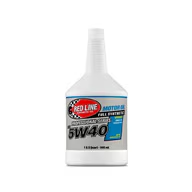 Red Line Professional 5W40 Engine Oil |  BMW 5W30 Engine Oil |
Recommended Oils - 2001-2013 M Engines (S54, S62, S65, S85)
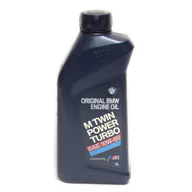
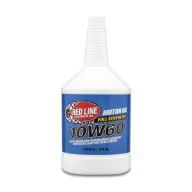
BMW used super-thick 10W60 oil in the S62, S54, S65, and S85 M engines of the 2000s. There is nothing fundamentally wrong with any of the various BMW/OEM 10W60 oils and we might recommend them over other oils (especially if your 3rd party warranty has explicit terms). With various complaints about rod bearings (including a factory recall on the S54) it might make sense for you to only use BMW-approved oil with your Genuine BMW bearings. But remove any warranty considerations and we ultimately prefer Red Line. Our top pick is the 15W50 - it has a thinner viscosity and lower pour point than factory BMW 10W60 even with a SAE 15W grade. This lower viscosity when cold means the oil penetrates the bearing surfaces and critical clearances more easily. When hot, the Red Line formula has similar evaporation and better shear resistance than factory oil, despite being graded as a 50 vs. 60. The thinner hot viscosity means less drag (more power) and less friction and heat. The Red Line is just a better formula using better base stock. Red Line also makes a 10W60 but it's a thicker viscosity than any other 10W60 and should only be used in track or very hot climates.
As with any engine, but more so with M engines, it is absolutely crucial that you warm the engine properly before subjecting it to high throttle angles and high RPM. Let the car warm up before driving aggressively - an optimum oil temp is 210-220°F on the gauge. And make sure your oil is "climate correct" - a thinner oil may be desired in freezing climates which is all the more reason to have the best quality oil.
The BimmerWorld View: 10W60 is not magic oil. It's just an SAE viscosity grade. A BMW-branded 10W60 is not a bad oil and we won't discourage you from using it. But there is so much more happening below the surface that we can toss out the viscosity and recommend an oil that is simply better in all respects. On tracked M engines (E46 M3, E9X M3) the Red Line products have greater shear strength, low evaporation, and high ZDDP. We can get all of that with the Red Line 15W50 that comes up to temp quicker and reaches tight tolerances easier. For street cars the factory BMW-branded 10W60 will be adequate and Red Line will be better.
The chart below provides several key laboratory tests on oil viscosity and was part of our decision to use 15W50. This data is readily available online, however, BMW does not publish oil specifications (except in a MSDS document). We included Shell Helix 10W60 as it's believed the BMW oil is based on this formula (although likely changed for BMW's spec). You can see the Red Line 50 weight is not as thick at the higher temp, but it's greater shear strength makes up for the lack of viscosity.
| HTHS (shear strength) (higher = stronger) | Viscosity @40C (104F) (lower = thinner oil) | Viscosity @ 100C (212F) (higher = thicker oil) | Pour Point C (oil stops flowing, colder temp = better viscosity) | |
| Red Line 15W50 | 5.8 | 138 | 19.6 | -49C |
| TwinPower 10W60 | unknown | unknown | 23.1 | -44C |
| Shell Helix 10W60 | 5.4 | 160.1 | 23.1 | -42C |
| Castrol Edge 10W60 | 5.2 | 168 | 24.2 | -39C |
Recommended Oils - 2012-2016 4-cyl Turbo Engines (N20, N26)
| Red Line 5W30 Engine Oil | 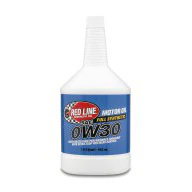 Red Line 0W30 Engine Oil | 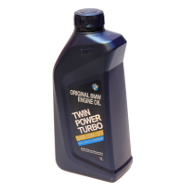 BMW 0W30 Engine Oil | 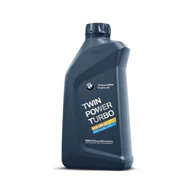 BMW 0W20 Engine Oil High Efficiency |
The N20 engine originally used the company-standard 5W30 engine oil. But as fuel economy standards were raised BMW switched the spec to 0W20. No mechanical or internal changes were made but this helped fuel economy and lower emissions. We would continue to recommend 0W20 for a daily driver but for any tuned engine, or any engine that sees aggressive driving or track use, we would rather see the Red Line 5W30, Red Line 0W30, or the BMW 0W30. Either Red Line will offer greater protection than the BMW oil and also be thin enough for cold start protection. In our own 328i race cars we used the Red Line 10W40 but that was for dedicated race use, sustained high RPM running, and religious warm-up procedures. Note: a previous version of this page had Red Line 5W40 Professional Series and this is still an option, especially with BMW factory approval, but we try to limit this space to four products and the 0W30 is more appropriate for street use.
Also see "Direct Injection" info below. The information from the N54/N55 engine oil also pertains to N20/N26/B46.
Recommended Oils - 2017+ 4-cyl Turbo Engines (B46)
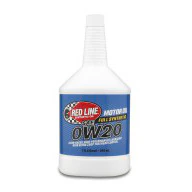
The B46 is an super-efficient engine for lower emissions and greater fuel economy. BMW uses a very thin oil to help deliver that better economy - a 0W20 with either LL14 or LL17 formulas. Looking over the limited amount of technical specs available, this 0W20 oil is about 30% thinner than the original 5W30 oil. Marketing backs this up with claims of improved fuel economy. The thinner oil is also beneficial for cold starts and continuous Stop/Start cycles. For these reasons we recommend staying with the Genuine BMW 0W20 oil or Pentosin 0W20 for normal driving in traffic. But it will never be a good oil for spirited driving or track use. If you regularly make runs to red line we recommend using the Red Line 0W20 which has good low temp specs but with more ZDDP for better strength.
For aggressive driving with regular runs to red line, we don't yet have an official recommendation. We need to know more about the engine internals, wear, and clearances to say which is our favorite oil. Just looking at paper specs, the BMW 0W30 may be a good option for sporty driving. It has slightly thicker viscosities and better HTHS strength than the BMW 0W20 but is not as thick as the Red Line.
Recommended Oils - 2007+ 6-cyl US Turbo Engines (N54, N55, S55, B58, S58)
| Red Line 5W30 Engine Oil | Red Line 10W40 Engine Oil | Red Line Professional 5W40 Engine Oil | BMW 0W30 Engine Oil |
Oil for Direct Injection (DI) engines.
In port-injected engines (basically all engines before 2007) the crankcase vent system would dump oil mist into the intake. A lot of this would end up on the back of the intake valves. The port injectors would spray gasoline into the intake and keep the intake valves relatively clean. However, DI engines have similar crankcase vent designs but move the fuel injector past the intake and directly into the combustion chamber so the valves no longer receive a cleansing spray. DI engines can also suffer from a weak crankcase vent system (CCV). The crankcase vent is designed to redistribute oil vapor from the engine through the intake and back into the combustion chamber. A poorly functioning CCV would let too much oil into the intake where it coats the intake valves with hardened carbon or sludge (the N54 twin-turbo engine is notorious for this). Auto and oil manufacturers now push oil formulas with low SAPS levels (Sulfated Ash, Phosphorus, and Sulfur), which are supposed to leave fewer carbon deposits. But the trade-off is lower wear protection at high operating temps (exactly what you don’t want in a highly tuned turbo engine).
The BimmerWorld View: Our happy compromise is the Red Line Euro Series oil (5W30 or 5W40) that meets BMW LL-04 oil spec. These are low SAPS oils that are safe for modern cats and DI engines. Red Line's better base stocks also have lower evaporation (NOACK) and higher ZDDP protection. It's just a better all-around oil than an off-the-shelf brand. The Red Line 0W30 also comes into play as a thinner version of the 5W30. It bridges the gap between BMW 0W30 and BMW 5W30. Use it for M cars or other models that get driven aggressively. For even better protection we use Red Line High Performance 5W30 and 10W40 but keep in mind that it has higher SAPS and ZDDP and is not good for modern ceramic cats (but great if you have metallic cats or have removed them altogether).
You can also change your driving habits to avoid oil sludge and build-up. The sludge comes from moisture that mixes with the oil vapor and then settles when the engine is shut off. Allowing the car to reach optimum temperature and avoiding short trips will burn off this moisture. Short trips are considered drives where the engine never reaches, or doesn't stay at, normal coolant temperature. Low RPM and constant minimum throttle will also fail to pull enough vacuum for the crankcase vent to work properly. We encourage regular runs up to high RPM and varying your throttle (an "Italian tune-up"). Yes, preventing poor CCV performance may be to get out and drive. But for the safety of yourself and others, please drive responsibly.
All of the above also applies to reducing Low Speed Pre-Ignition (LSPI). This is ignition of the air:fuel mixture before the planned spark plug firing and during the compression stroke of the piston. Pre-ignition can be extremely damaging to pistons and cylinder walls as the air:fuel mixture ignites while the piston is on the way up instead of on the way down. Pre-ignition in general is usually caused by heat, or a hot surface, or compression pressures. Carbon deposits can retain heat and get hot enough in some spots to ignite the fuel by accident. Carbon build-up is the primary cause of LSPI so the above advice also applies for mitigating LSPI. Oil choice will also play a factor, especially when using older oil formulas with higher ZDDP or with extended change intervals where "burned" oil is present. The newest SN Plus API oil spec includes additives meant to reduce LSPI. Higher octane fuel and flex fuel are also more resistant to pre-ignition.
Other Interesting Sources
Terminology & Acronyms
Below are some explanation of the scientific terminology, jargon, and acronyms commonly used when discussing BMW engine oil.
| ACEA | Association of Constructors of European Automobiles. Rates and grades the quality of motor oil according to their own specifications. For gasoline BMWs, the ACEA rating should be A3/B3 or higher. |
| API | American Petroleum Institute. Rates and grades the quality of motor oil according to their own specifications. If you look at a bottle of oil it will have a "API XX" stamp. As new oil formulations are announced the rating gets progressively "higher" - SJ, SM, SN, SN Plus, SP, etc. For gasoline BMWs, the API rating should be SJ or higher. You can use the API rating to judge how appropriate the oil is for your needs. SJ is an older spec and will have more ZDDP and additives that make it a "better" oil (in our minds). The newer SP and SN formulations will be focused on fuel economy and emissions. These are not "bad" oils and may be fine for daily use. But look elsewhere if you want a better oil for your needs. API also has Diesel oil ratings that use different labels but with similar meanings. Current specs are CK-4 for 2017 or CJ-4 for 2010 or CI-4 for 2002. The "4" in the label refers to a 4-stroke engine so stay away from any Diesel oil with a "-2" rating. Diesel oil can be used in gasoline cars but there are restrictions. See Diesel oil paragraph above. |
| Diesel | A type of internal combustion engine that uses extremely high levels of compression instead of a spark plug to ignite the air/fuel mixture. A capital "D" is the correct spelling as the engine technology was patented by Rudolf Diesel. |
| Base Stock | Base Stock is the material that oil starts from - petroleum-based or true synthetic. All oil is classified under one of five Groups, I-V. Groups IV and V are full synthetic and have no petroleum base. They use synthetics that are more resistant to heat and stress than petroleum-based oil. High Performance and Racing oil are almost always Group IV or V. Groups I, II, III are all petroleum-based with III being the highest quality. All BMW-approved oils are Group III yet are still marketed as synthetic oils. This is to avoid confusion with the different base stocks of Group IV (PAO) and V (ester). Any oil brand that wishes to be approved by BMW must be a Group III base stock. So it's common to see premium high performance oil that is better than BMW oil but does not have BMW approval. Red Line Oil encountered this with their own High Performance oil that could not be BMW approved due to their Group IV and V base stock. They had to formulate a different oil with a Group III base to get the BMW approval (Red Line Professional Series). This oil actually performs worse than their High Performance oil in laboratory tests but carries the BMW stamp of approval. |
| Dino Oil | You may see references to this, especially on oil-focused message boards. Dino oil is non-synthetic, petroleum-based oil from dinosaurs. Dino/petroleum oil lacks the same additives and detergents of modern synthetic oils so it has fallen out of favor, except in the vintage car community. |
| FE or FE+ | Fuel Economy and Fuel Economy Plus. Oils with additives that allow a lower viscosity for better fuel mileage. The additives have similar protective properties as thicker oils but allow a thinner viscosity. |
| HDEO | Heavy Duty Engine Oil (sometimes with Diesel in the name). Extra thick and with additives that make it well suited for older or high mileage engines with “loose” production tolerances. These oils tend to run thicker than others so more wear and noise is to be expected on cold starts and fuel mileage may decrease slightly. The additives trap and contain dirt and foreign particles better than a straight passenger car oil. This is common oil in Diesel engines in dirty environments - farms and construction sites. |
| HTHS | High Temperature / High Shear conditions. This is used to pinpoint areas in the engine that have high temperatures and friction and the oil is at risk of “shearing” or breaking down (camshaft and valve lifter surfaces, for example). A higher HTHS grade means the oil is more resistant to shearing in these conditions. However, a lower HTHS is desired for efficiency. It is expressed in centipoise (cP), a unit of viscosity. Until c.2014 BMW specified a HTHS of 3.5cP. The latest LL-14 spec fuel efficient oil has a cP of 2.6-2.9; for comparison, water has a 0.899cP. For high performance and track use we want a oil that stays thicker, not thinner. |
| LL | Longlife. BMW’s name for oils that are approved for extended oil change intervals. |
| LSPI | Low Speed Pre-Ignition. A phenomena where the air:fuel mixture is ignited before the spark plug has fired. This is usually caused by carbon present in the combustion chamber and residual temperatures that get hot enough to burn fuel. This has been widely reported with direct injection engines, especially with large carbon build-up. See the section above on "Oil for Direct Injection (DI) engines". |
| NOACK | A grade for how much oil is lost due to evaporation. The thinner portions of oil evaporate first, leaving behind a thicker fluid. An oil that is more resistance to evaporation will hold up better at higher operating temps. The higher the number the more fluid is evaporating. Really high quality oil will have a low NOACK value. |
| OCI | Oil Change Interval, or how often you change your oil. BimmerWorld recommends an OCI of 5,000 miles for street cars and more often for track/racing cars. |
| Racing Oil | Oil sold for off-road and racing use is not subject to the same regulations and approvals as standard passenger car oils. Race cars also do not tend to have catalytic converters, therefore, oil manufacturers do not have to engineer their racing oils for fuel economy or emissions. Also, race cars tend to have much more frequent oil changes so there is no need for extra detergents. Racing oils are not very well suited for street cars. |
| SAE | Society of Automotive Engineers, responsible for setting the oil viscosity grades. |
| SAPS | Sulfated Ash, Phosphorus, and Sulfur. Newer oils have a low SAPS value - the levels of these materials is low which is good for the environment and the catalytic converters. However, to get low SAPS more synthetic additives are required which have less protection, especially in higher operating temps. Low SAPS oils are common for Direct Injection engines (see section above). Oils with a ACEA Class C rating must be low SAPS. |
| TBN | Total Base Number is a grade for the amount of active additive left in used oil. This will be displayed in a UOA and gives an indication of how “used up” the oil is and if the owner can safely extend the OCI further. Fresh oil starts out with a TBN between 6.0-14.0 depending on type. The higher the number, the better. |
| UOA | Used Oil Analysis, recommended to determine the performance of motor oil and assess internal engine wear. UOA is especially important for S54, S62, S65, and S85 M engines to evaluate rod bearing wear. |
| Viscosity | The rating for the internal friction of fluid dependent on temperature. The SAE assigns the grade based on two temperature standards: cold (the “W” in 5W40) and high (100*C). The higher the number, the thicker the oil is and the longer it will take to reach operating temperature. The thicker oil also has more resistance on moving parts, which is why BMW has recently adopted low friction 5W and 0W oils to reduce cold start friction and improve efficiency. In addition to the familiar SAE grades, viscosity is expressed in centiStoke units (1 cSt = 1 mm2/s) and measured at two different temperatures - 40*C and 100*C. A higher cSt is a thicker oil, giving more protection but less efficiency. However, a low viscosity does not automatically mean less protection (the chemical makeup of the oil determines that). |
| ZDDP | Zinc-Dialkyl-Dithiophosphate, a metallic additive in older engine formulations. ZDDP has anti-wear properties that have been replaced with synthetic additives because of environmental reasons. Higher ZDDP is also bad for modern catalytic converters if poor ring seal allows oil into the combustion chamber. However, the great advantage of higher ZDDP is that it bonds to the surfaces and provides excellent lubrication even at high temps. This is great for higher mileage engines with loose tolerances - the extra ZDDP helps fill the gaps that were not there when the engine was new. High ZDDP oils will also tend to have high HTHS ratings, making them attractive in high performance engines, especially tuned turbo engines. Environmental regulations required oil manufacturers to reduce ZDDP levels in gasoline oil. However, Diesel oil still contains high ZDDP levels which is why you will often hear engine builders and enthusiasts recommending it. However, don’t just grab oil with the highest ZDDP or straight Diesel oil. A high ZDDP must match the API and ACEA ratings for your BMW. |
Shop for BMW Engine Oil, Transmission Fluid, & Differential Fluid
| Sort by Name | Sort by Price |